How Much Does It Cost to Wire a Self-Contained Apartment in Accra? Complete Breakdown
Wiring a self-contained apartment—whether a single-room studio setup or a chamber-and-hall layout—is a crucial milestone when developing or renovating property in Accra. Because residential rental demand across neighborhoods like Madina, East Legon Hills, Dansoman, Lapaz, and Spintex continues to grow, executing a safe, cost-effective, and code-compliant electrical installation is essential for both property owners and tenants.
Understanding the total cost to wire a self-contained unit requires evaluating heavy material pricing (conduits, copper cables, switchgear), certified labor rates, and official regulatory compliance under the Energy Commission of Ghana (L.I. 2008) regulations. This guide provides a detailed technical breakdown of average wiring costs, execution stages, and budgeting advice tailored to the Accra construction market.
Estimated Cost Breakdown for Wiring a Self-Contained Unit in Accra
In the current Accra real estate market, completely wiring a self-contained apartment (covering materials, switchgears, pure copper cables, labor, and safety testing) generally costs between GHS 5,500 and GHS 10,500.
The total financial commitment is divided into three main operational categories:
1. Conduits, Pure Copper Cables & Accessories (Approx. GHS 2,800 – GHS 4,800)
First-Fix Conduits: Heavy-duty PVC conduit pipes, metal flush back-boxes (3×3 and 3×6), circular junction boxes, and solvent cements.
Fire-Retardant 100% Pure Copper Wires: 1.5mm² single-core cables for lighting and fans, 2.5mm² cables for 13A ring socket loops, and 4.0mm² or 6.0mm² heavy-duty lines for air conditioners or water heaters.
Accessories: Standard 13A switched double sockets, 1-gang/2-gang light switches, ceiling fan speed regulators, and AC isolator faceplates.
2. Consumer Unit Distribution Panel & Earthing (Approx. GHS 1,200 – GHS 2,200)
Sub-Distribution Board (6-Way or 8-Way DB Board): Main 63A double-pole isolator switch, Miniature Circuit Breakers (10A for lights, 20A/32A for sockets).
Anti-Electrocution Protection: Mandatory 30mA Residual Current Device (RCD/RCCB) and Type 2 Surge Protection Device (SPD) to shield electronic equipment against ECG power surges.
Earthing Grid: Pure copper earthing rod, heavy brass earth clamp, inspection pit box, and bare earthing conductor.
3. Certified Labor & Energy Commission Testing (Approx. GHS 1,500 – GHS 3,500)
Covers all wall chasing, floor slab piping, cable pulling, panel termination, and official insulation continuity testing required to obtain the Electricity Company of Ghana (ECG) meter connection.
Technical Step-by-Step Breakdown of Apartment Wiring
Executing a code-compliant electrical setup for a self-contained unit follows four mandatory engineering phases:
Phase 1: Wall Chasing and Conduit Embedding (First Fix)
Before wall plastering, technicians use specialized wall chasers to embed 20mm heavy-duty PVC conduit pipes into concrete block walls.
The Golden Rule: All conduit channels must run strictly vertical or horizontal. Diagonal chasing is prohibited under national wiring codes as it leads to accidental drilling through live wires in the future.
Phase 2: Cable Drawing and Circuit Separation (Second Fix)
Once plastering cures, fire-retardant 100% pure copper single-core cables are pulled through conduits using fish tape:
Lighting Outlets: $1.5\,\text{mm}^2$ copper cables on a 10A Miniature Circuit Breaker (MCB).
General Socket Outlets: $2.5\,\text{mm}^2$ copper cables on a 20A or 32A breaker ring.
High-Power Load Lines: Air conditioning units and water heaters require isolated $4.0\,\text{mm}^2$ cable lines running straight to the main distribution panel to prevent voltage drops or circuit overloads.
Phase 3: Consumer Unit Panel Termination & Earthing Assembly
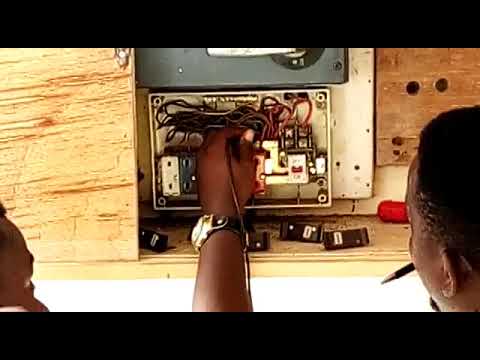
All branch circuits converge at the central consumer unit. The installation must integrate a 30mA RCD to protect occupants against fatal electric shocks. Simultaneously, a copper earth rod is driven deep into moist soil to guarantee a low-resistance grounding path.
Phase 4: Pre-Commissioning Inspection & Form A Certification
Under L.I. 2008, an uncertified house installation will be rejected by ECG. A Certified Electrical Wiring Inspector (CEWI) performs insulation resistance, polarity, and loop impedance tests before issuing an official Installation Completion Certificate (Form A) for meter connection.
Why Choose ESCA Tech Electrical Company in Accra?
Cutting corners with uncertified artisans in Accra often results in cheap copper-clad aluminum (CCA) wires, melted insulation, electrical fires, and rejected ECG meter applications. ESCA Tech Electrical Company is your certified electrical engineering partner in Ghana.
Here is why property developers and owners across Accra choose ESCA Tech:
Energy Commission Certified Team: All projects are managed by licensed wiring professionals operating strictly under national safety codes (L.I. 2008).
Transparent Bills of Quantities (BOQ): You receive detailed material schedules and accurate estimates upfront, eliminating mid-project pricing inflation.
100% Genuine Materials: ESCA Tech sources certified fire-retardant pure copper cables and genuine switchgears.
Hassle-Free ECG Processing: ESCA Tech conducts all mandatory safety tests and issues official Form A certificates for rapid meter connection.
Get Your Custom Apartment Wiring Estimate Today
Safeguard your building investment, protect your tenants, and obtain an accurate Bill of Quantities estimate for your self-contained apartment in Accra.
Contact ESCA Tech Electrical Company right now to schedule a site inspection or speak with a technical consultant:
Phone / WhatsApp: +233552471234
Email: escatechafrica@gmail.com